Wieda & Zorge are keeping things in perspective, …
But they build their pretty bell towers on hills overlooking their villages, where they can be seen from far away.
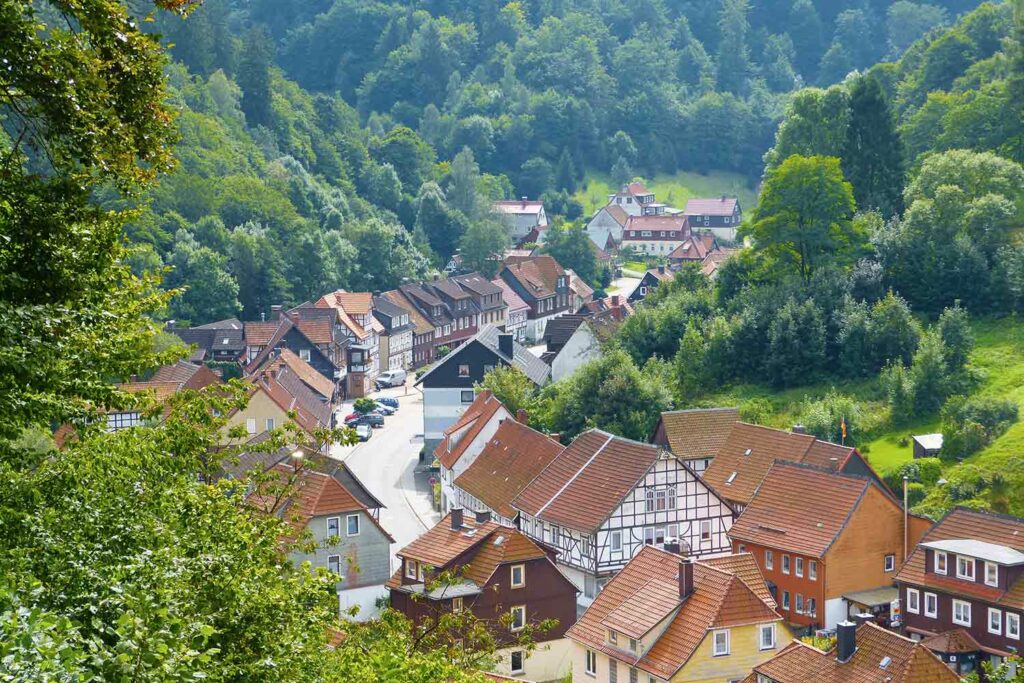
The towns of Wieda and Zorge wind their way for long stretches through the valleys of the rivers from which they take their names. Thanks to the elevated design of the freestanding bell towers, the sound of the bells carries across the entire valley and can be heard by all the residents.
Incidentally, this has also created two picturesque hiking destinations and scenic overlooks—must-see spots for any visitor to the municipality of Walkenried.
Zorge
St. Bartholomew Church
The Protestant St. Bartholomew Church has been a defining feature of Zorge’s townscape since 1853. Its origins, however, go back much further: as early as 1577, an abbot from the Walkenried Monastery had the first chapel built on the Kirchberg. At the beginning of the 18th century, a wooden church was built on the same site, before the current Neo-Gothic hall church—constructed of grauwacke and dolomite according to plans by Carl Theodor Ottmer—was built starting in 1847. After extensive renovation, it was rededicated in 1987 and now also serves as a community center.
Zorge
Bell tower
A distinctive landmark of the village is the freestanding yellow bell tower above the village. It has been part of the Braunschweig Cultural Heritage Foundation since 1934, is a designated historic monument, and underwent extensive restoration in 2019. Since then, a historic bell from Finland has been ringing here.
It’s worth the climb: A staircase with 190 steps and an elevation gain of about 60 meters leads you to the tower, where you’ll be rewarded with a breathtaking view of the entire valley. Nearby, you’ll find a parking lot, a bus stop, and hiking trails leading into the Kunzental Valley and to the Hammerschmiede.
Wieda
Bell tower on the Käseberg
High above Wieda, on the Käseberg, stands the striking yellow bell tower—one of the town’s most famous landmarks. From here, at an elevation of about 375 meters, you can enjoy a sweeping view of the village in the valley and the surrounding hills.
The freestanding wooden bell tower is visible from many places in the village. The hike up the trail at the edge of town is particularly charming, as it perfectly combines a nature experience with scenic views.
Wieda
Lutherkirche
The current Protestant church was consecrated in 1778, along with the bell tower. An earlier church had stood on the site since 1610. Since 1984, it has been known as the Lutherkirche, in honor of the Reformer Martin Luther.
Walkenried
Monastery
Church life in Walkenried is closely tied to the former Cistercian monastery. The Protestant congregation holds its services in the historic chapter house, which has been used for this purpose since 1570 and still offers a special atmosphere today.
Walkenried
Holy Cross Church
The Catholic Church of the Holy Cross rounds out the area’s offerings. It was built in 1959 according to plans by Josef Fehling and consecrated in April 1960. The simple, single-nave structure, with its bell tower topped by a cross, adds a modern architectural touch to the town.
Hiking Tip
Take a hike to the Wieda Bell Tower along the Bee Trail. Here, you’ll learn everything there is to know about why these furry honey collectors are so important to our own lives and what we should do to ensure the survival of the bee population—a topic that concerns us all, explained in an engaging way.
Discover the neighborhoods of the Walkenried municipality
Walkenried
The monastic town of Walkenried is known for its Cistercian monastery and UNESCO World Heritage Site, which attracts numerous visitors interested in culture every year. Nestled in the Harz forests, Walkenried also offers recreational activities for young and old alike.
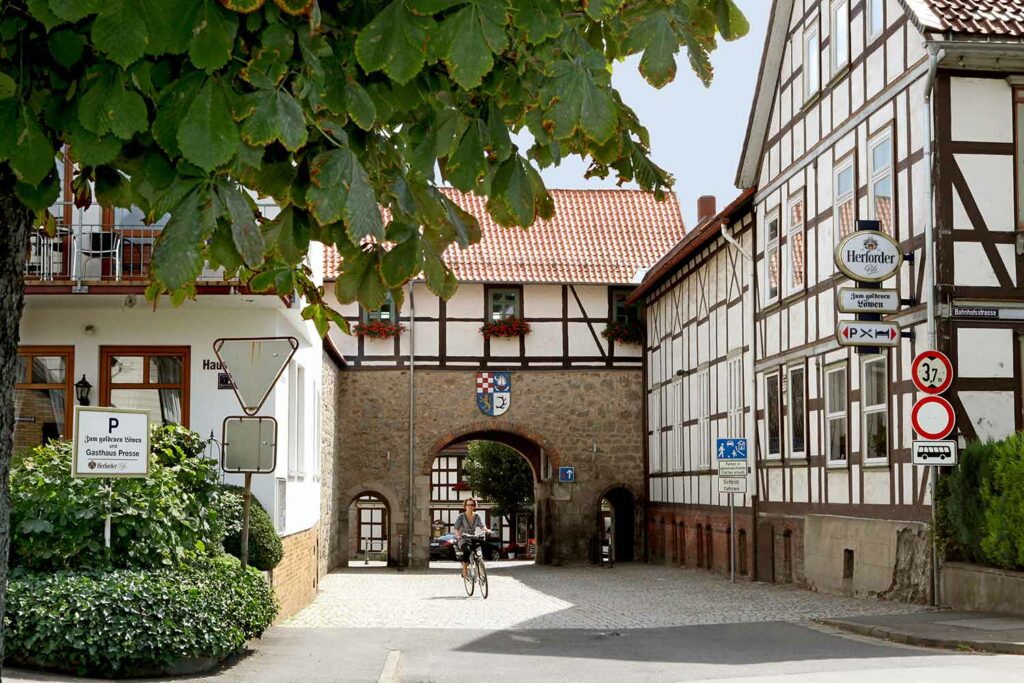
The small town of Wieda in the southern Harz Mountains charms visitors with its beautiful half-timbered houses and long tradition of mining and glassmaking. During the Advent and Christmas season, the countless lights of the Wieda Nativity Scene Festival illuminate the idyllic village—a must-see for every visitor to the Harz Mountains.
Take a deep breath in Zorge: fresh forest air, mountainous scenery, and dense forests are perfect for moments of relaxation in nature. Lush and green in summer, glistening white in winter—Zorge is worth a visit any time of year.